
Acnocell
JeuDérmAdvanced Skincare
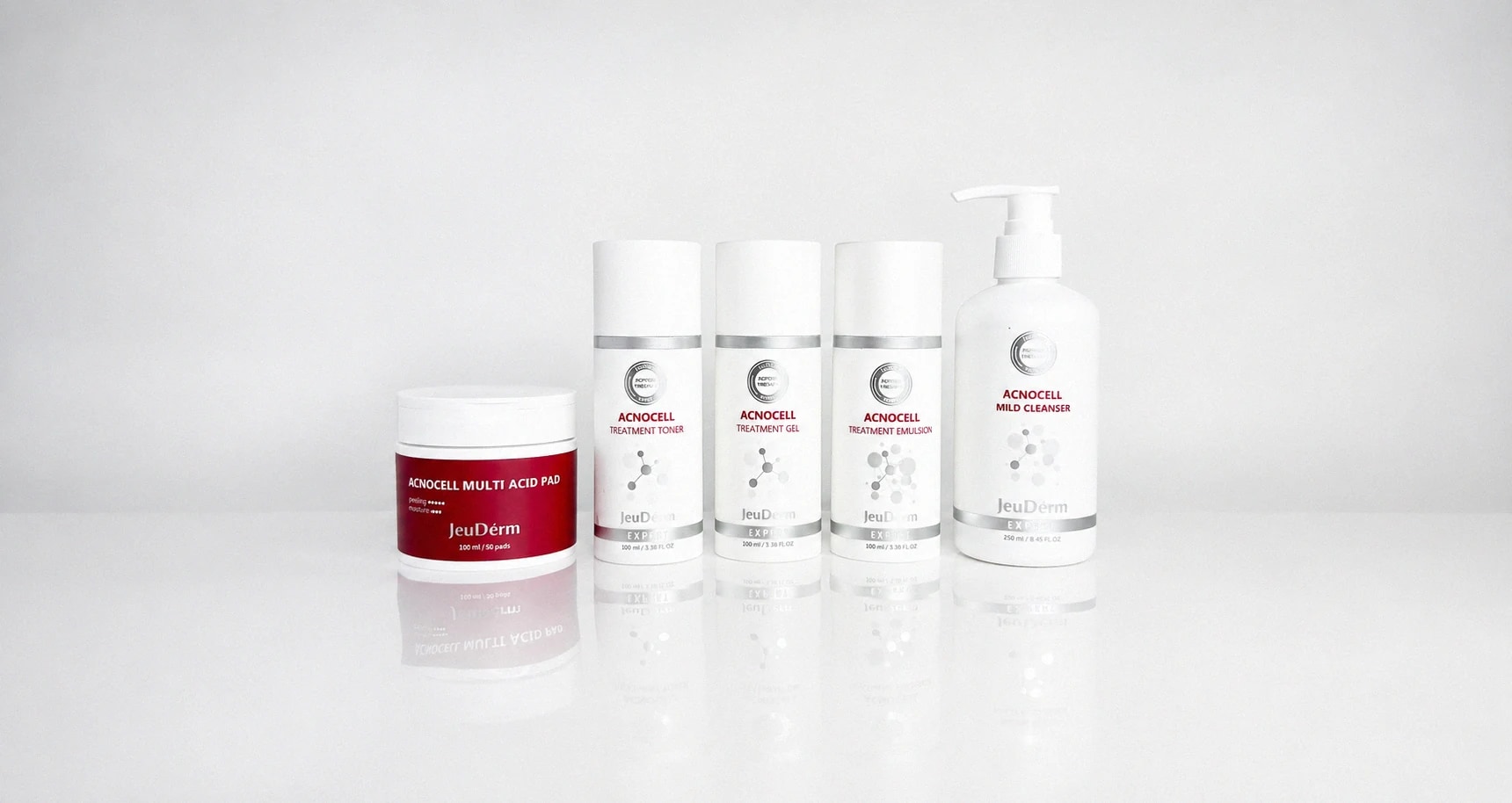
About the line
ACNOCELL™ is the peptide line that institutes and practices work with, and from which Virta-Med has derived its own home care, so that the result holds between two appointments.
Developed for oily and blemish-prone skin, for skin of any age. Because excess sebum is not a question of youth: it also accompanies the adult client whose skin has changed hormonally.
Effect
Antimicrobial
The killer peptide Aknotid targets pathogenic microbes in a body-identical way.
Anti-inflammatory
Copper peptides and herbal complexes calm inflamed, irritated skin.
Brightening
Demelaxil and glutathione inhibit tyrosinase and prevent dark post-acne marks.
For whom
Assignment by skin condition
| Condition | Recommendation |
|---|---|
| Oily skin, large pores | full routine, steps 1–5 |
| Combination skin | Cleanser, toner, emulsion; gel as a spot treatment |
| Oily but sensitive skin | Cleanser and toner; introduce the pad slowly |
| Uneven texture | Focus on the Multi-Acid Pad |
| What remains after the blemishes | Multi-Acid Pad, gel and emulsion |
| Hormonal blemishes on mature skin | Gel as a spot treatment alongside the usual care, plus the toner, without changing the rest of the routine |
Individually or complete: both work. The six articles are designed as a sequence, but each step stands on its own: a client who already has a serum and a cream she is happy with adds the gel as a spot treatment or the toner as an intermediate step. That is often a better start than a complete switch.
For the first-time client: cleanser and toner. Two steps, no risk. After four weeks add the emulsion. Once the skin is stable, the gel as a spot treatment, then the pad. This order matters: whoever gives everything at once cannot tell, in case of a reaction, what caused it.
At a glance
The profile
- Product category
- Cosmetic product under Regulation (EC) 1223/2009, not an acne therapy
- Field of application
- Oily and blemish-prone skin, any age
- Scope
- Six products in nine article numbers, three of them in two pack sizes, one each for treatment room and home care
- Professional goods
- Four articles carry the print FOR PROFESSIONALS ONLY
- Manufacturer
- Virta-Med Korea Co., Ltd., Daejeon (developed in its own laboratory)
- Lead active
- Peptide complex, 330 ppm printed on gel and emulsion · niacinamide in position 3 of the declaration
The sequence
6 products, one order
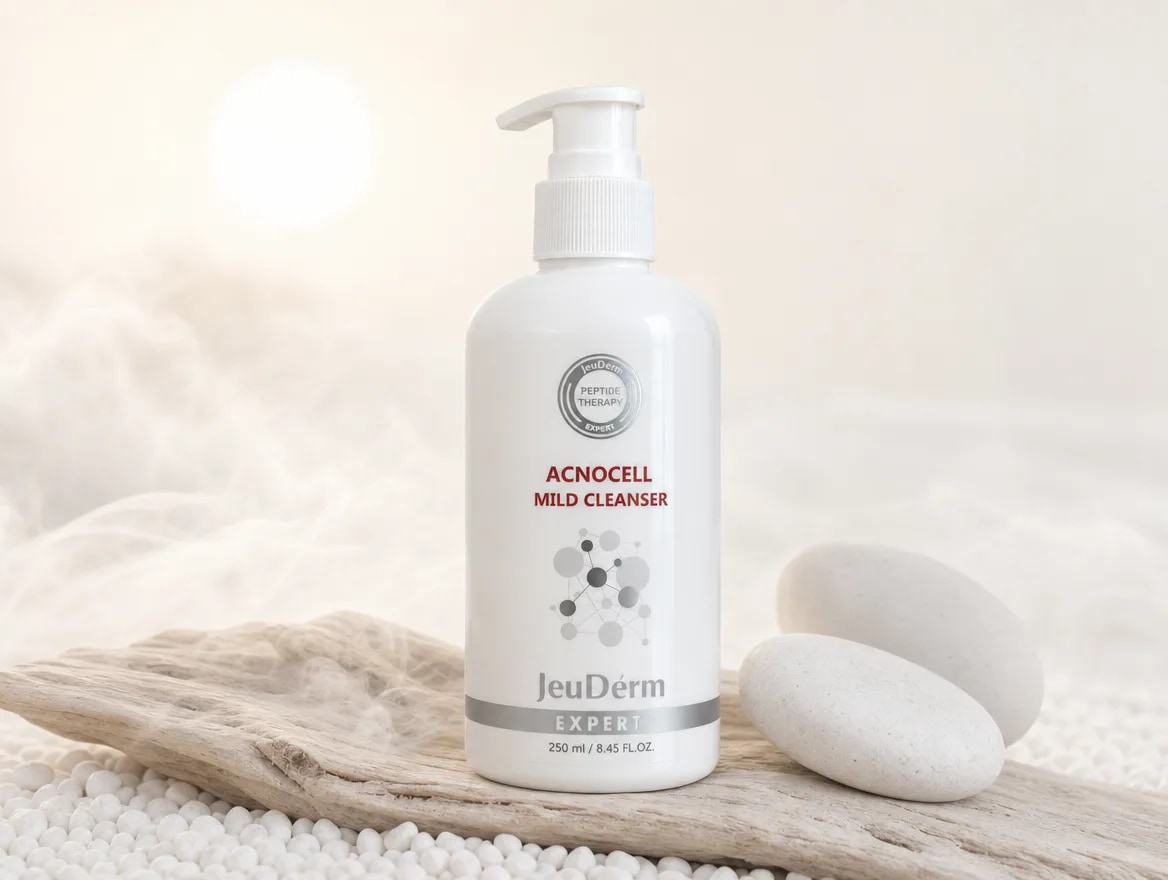
1
Bottle 250 ml · morning and evening
Mild Cleanser
Cleansing with phosphate ester surfactants, 50 ppm peptides
The cleansing gel of the line, and the only step that is rinsed off again. It dissolves sebum and make-up without attacking the barrier: the cleansing work is done by two phosphate esters in positions 2 and 3 of the declaration.
Contains among others
Laureth-1 Phosphate and Lauryl Phosphate · 50 ppm peptides · salicylic acid · zinc sulfate · guaiazulene · beta-glucan · allantoin · eight plant extracts
In the system
Over-cleansed skin absorbs actives less well and reacts more sensitively. This step decides how well everything that follows can work.
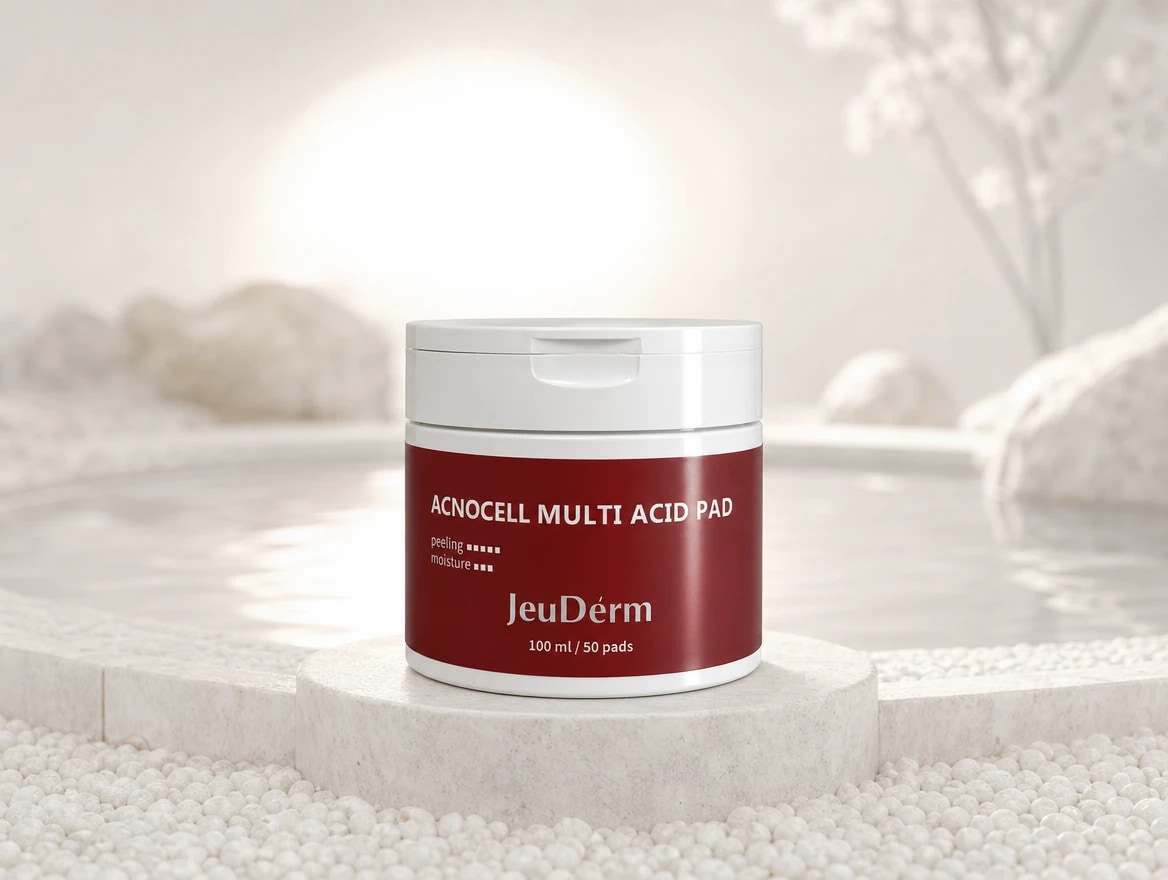
2
50 soaked pads · one pad, in the evening
Multi-Acid Pad
Exfoliation in the evening: tranexamic acid leads, ceramide NP
The daily exfoliation, as a single pad in which overdosing is technically impossible. The first acid in the declaration is tranexamic acid, not salicylic acid: this peel targets the traces that remain after the blemishes, not the sebum.
Contains among others
Tranexamic acid · mandelic acid · glycolic acid · citric acid · salicylic acid · oleanolic acid · ceramide NP · Centella asiatica · sixteen plant extracts
In the system
The loosened horny layer is the reason why toner, gel and emulsion get through afterwards at all. The ceramide balances what the acid costs.
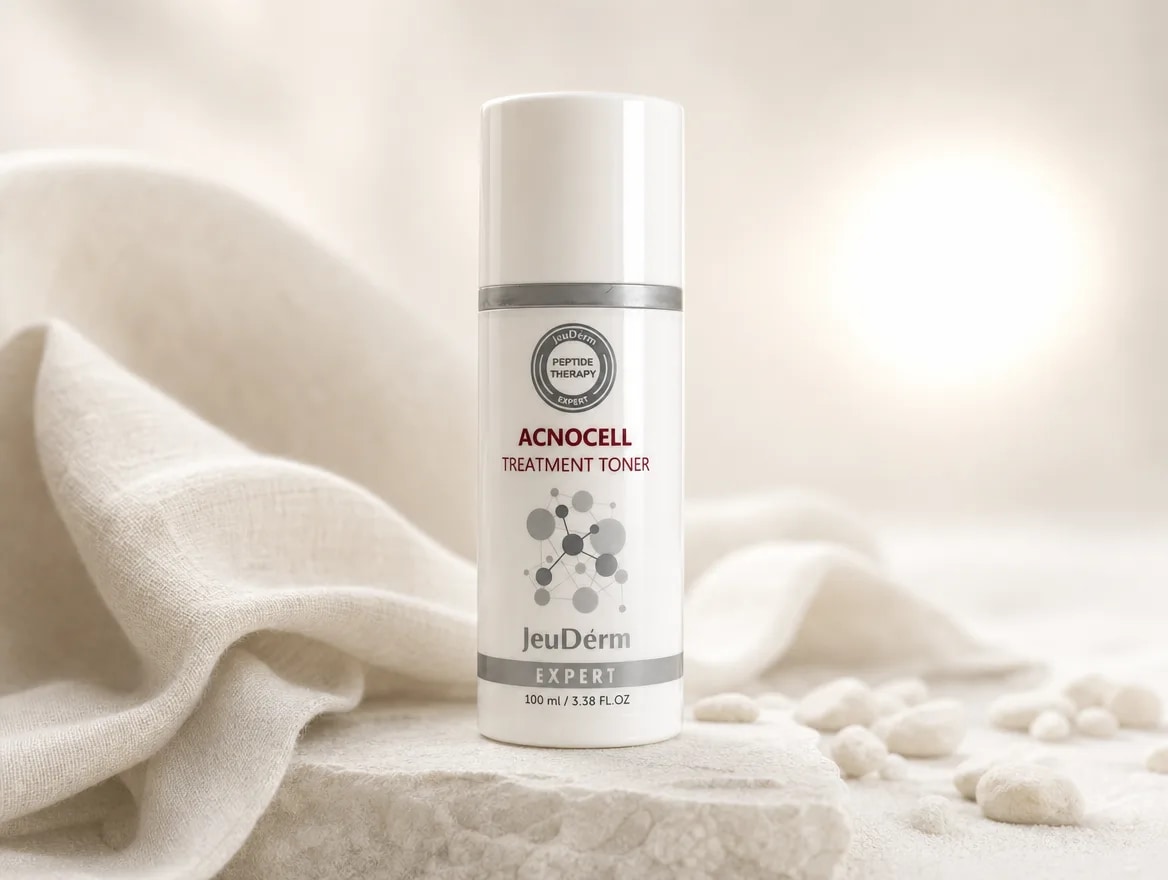
3
Pump bottle 250 ml (treatment room) · 100 ml (home care) · morning and evening
Treatment Toner
no ethyl alcohol, niacinamide in position 4 of 26
The first step that stays on the skin, and thus the first real active step. Niacinamide is in position 4 of only 26 positions, the shortest list of the line. No ethyl alcohol, although that would be the rule for toners for oily skin.
Contains among others
Niacinamide · salicylic acid · willow bark extract · dipotassium glycyrrhizate · panthenol · hydroxyethyl urea · Copper Tripeptide-1 · Hexapeptide-61 Dimer
In the system
Not a pure water toner: hydrogenated lecithin and olive esters form a light emulsion system. That is why it is massaged in rather than wiped off, and it lays the foundation for the gel.
4
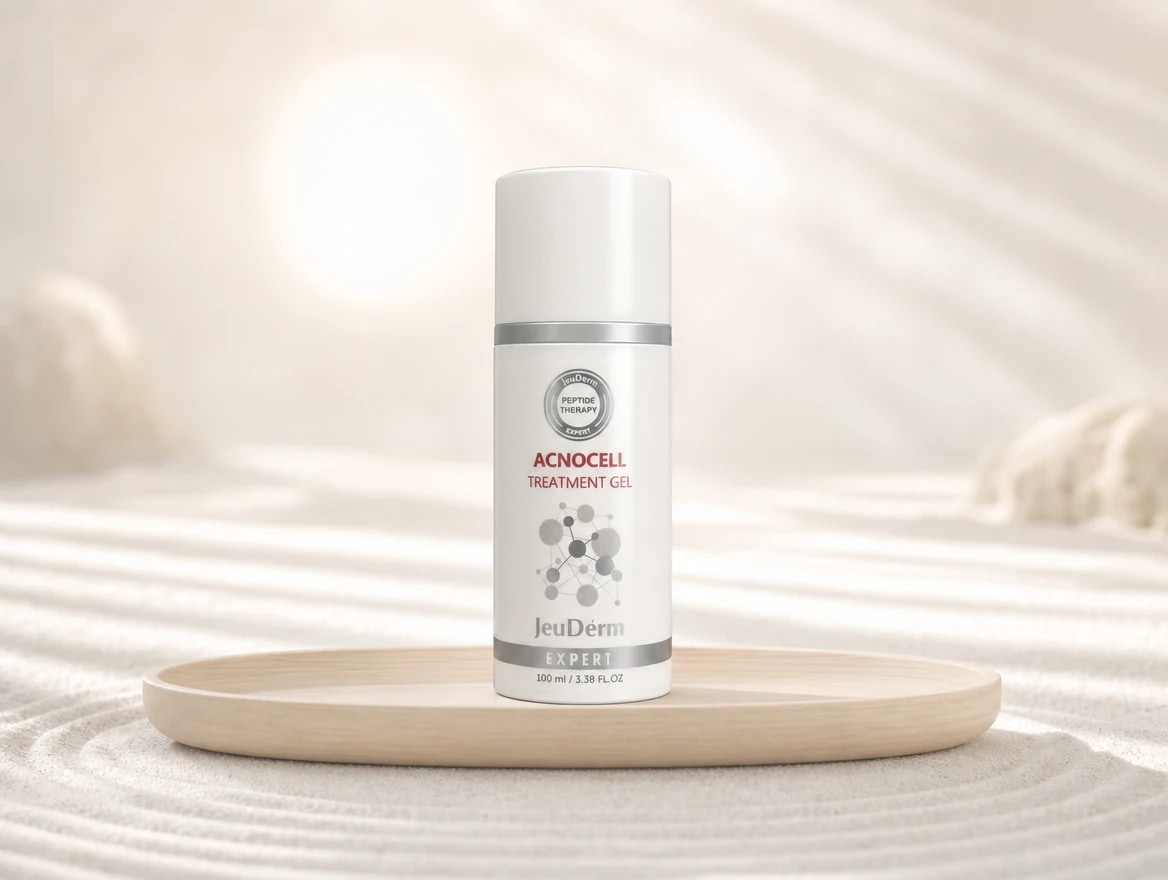
150 ml (treatment room) · 100 ml (home care) · spot treatment, do not rinse
Treatment Gel
spot treatment: 330 ppm, niacinamide position 3 of 50
The active step of the line, applied to the affected areas. 330 ppm peptides and niacinamide in position 3 of 50, the highest active density of the range. Without salicylic acid and without alcohol.
Contains among others
330 ppm peptides · niacinamide in position 3 · witch hazel in position 5 · zinc sulfate · sodium hyaluronate · panthenol · adenosine · Bifida Ferment Lysate · eleven plant extracts
In the system
The manufacturer additionally names the gel as a contact medium for device techniques and as combinable with LED, so it also works during the treatment, not only afterwards.
5
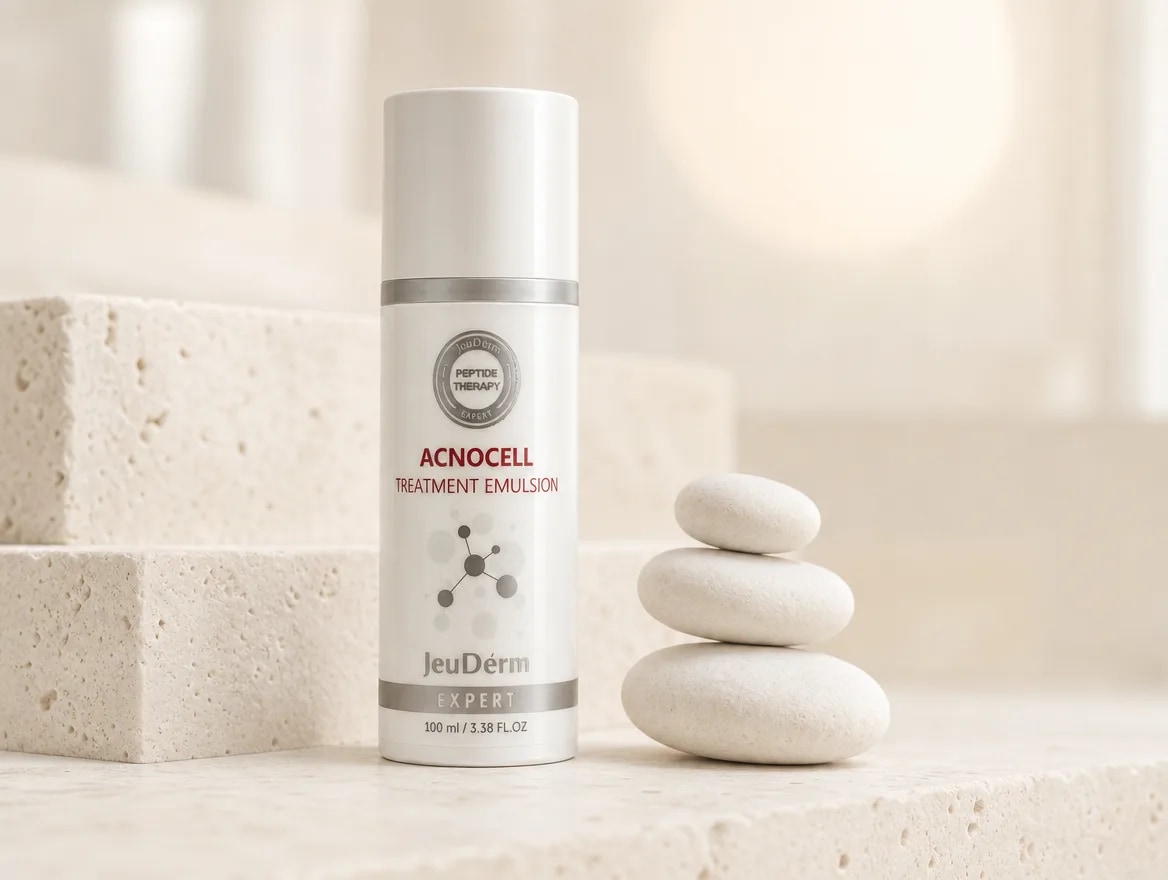
Pump bottle 150 ml (treatment room) · 100 ml (home care) · all over, after the gel
Treatment Emulsion
all over after the gel: 330 ppm, triple centella
The all-over finish, and the step that most lines for oily skin leave out. The same 330 ppm as in the gel, niacinamide again in position 3, plus a triple-built centella complex: the whole extract plus the two isolated lead substances.
Contains among others
330 ppm peptides · niacinamide in position 3 · asiaticoside, centella extract and madecassoside · Houttuynia cordata · zinc sulfate · beta-glucan · allantoin
In the system
Whoever skips the care step dries the skin into sebum overproduction. The emulsion is the reason the result holds after four weeks instead of tipping over. The pack says: after the Treatment Gel.
Treatment room
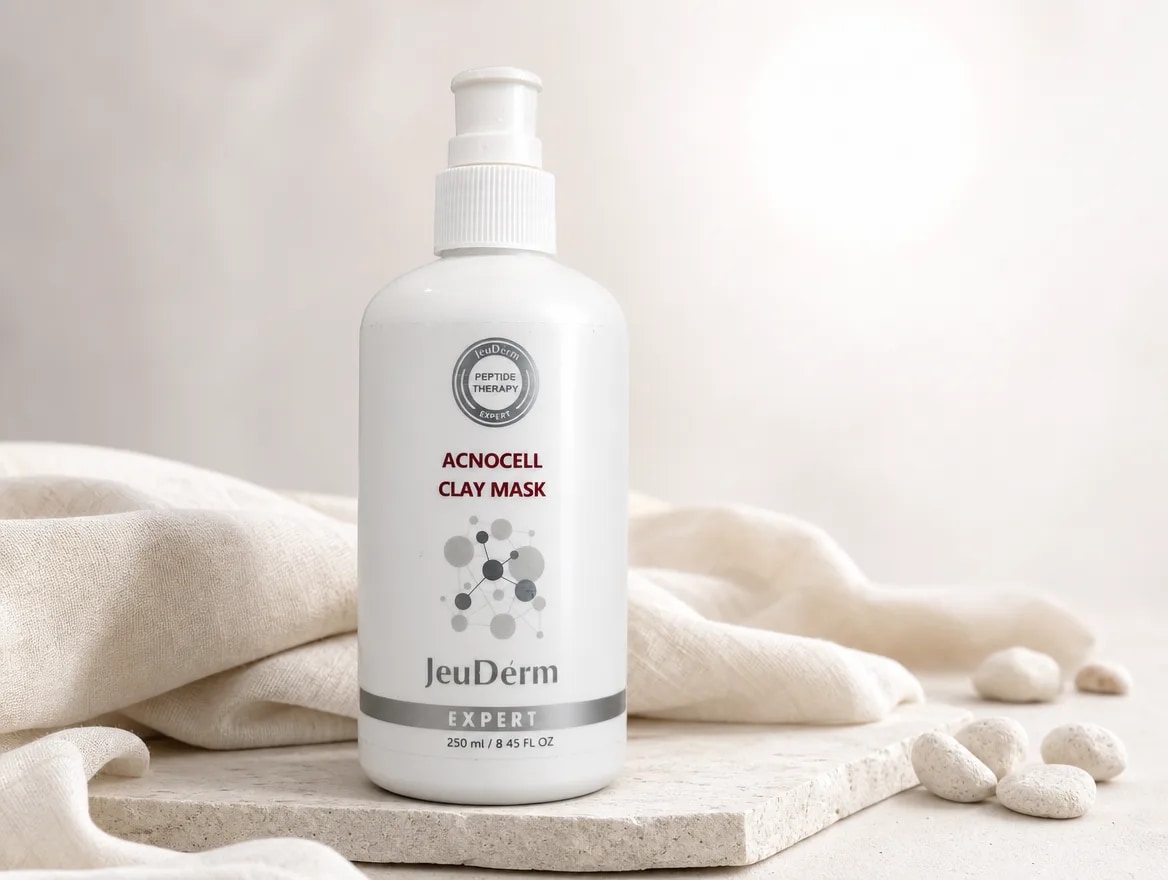
Bottle 250 ml · 15 minutes, once or twice a week
Clay Mask
Kaolin mask, 15 minutes, once or twice a week
The kaolin mask for the treatment at the institute. It dries on and degreases: that is its job and the reason it is not used on irritated skin.
Contains among others
Kaolin · sh-Oligopeptide-1 and -2 · sh-Polypeptide-1 and -22 · Copper Tripeptide-1 · chaga · tea tree oil · aloe · Baikal skullcap · liquorice · green tea · sodium hyaluronate · trehalose
In the system
The step that does not exist at home. It sets the mark in the treatment room that the home care then holds for four weeks.
The order of steps 4 and 5 is printed on the pack itself: the emulsion carries the print “Recommended to be applied after Treatment Gel”.
Why the articles work better as a system
Each step makes the next more effective. The cleansing decides how receptive the skin is. The peel opens the way. The toner is the first step that stays. The gel places the highest concentration where it is needed. And the emulsion prevents the skin from answering all of that with even more sebum.
This becomes visible in one number: the printed peptide concentration rises along the sequence, from 50 ppm in the cleansing step to 330 ppm where the product stays on the skin.
A line built for treatment rooms
- Made in Korea
- Six products
- One system
3 ways into the line
Complete care programme
Five steps for home, from cleansing through peeling to the finishing step.
Building block in the treatment plan
Combined in the treatment room according to findings, with device technology, stronger peels or other lines of the house.
Single step
The gel as a spot treatment, the toner as an intermediate step: slotted into an existing routine without changing it.
- Made in Korea
- Own R&D laboratory in Daejeon
- Patent KR 10-1689878
- 330 ppm on the pack
In depth
The dossier
01Two worlds, one systemTreatment-room sizes and the home care derived from them
The treatment-room sizes of the ACNOCELL line carry the print FOR PROFESSIONALS ONLY. They are made for work in the institute and the practice, in application forms and sequences that require professional training.
Which articles are used in which order, in what quantity and at what interval is decided by your beautician according to the skin findings. That decision is the actual service: no product takes it from her, and none replaces it.
For the time between appointments, Virta-Med has derived a home care from the same development. It is deliberately built so that it carries the work of the treatment room instead of repeating it, and thus makes part of this research accessible outside the institute for the first time.
For your institute
Treatment-room sizes
With the print FOR PROFESSIONALS ONLY. ACNOCELL rarely stands alone in the treatment room: the Treatment Gel is intended as a contact medium for device techniques and in combination with LED, the exfoliation can be replaced by a stronger professional peel, and the sequence combines with other lines of the house. What is combined with what is decided by the findings, not the catalogue. Professional instruction and treatment planning via the JeuDérm Academy.
For your skin at home
The derived home care
In consumer sizes. The same handwriting, the same origin, matched to what was begun at the institute.
Evidence The print FOR PROFESSIONALS ONLY appears on the treatment-room sizes of Treatment Toner (250 ml), Treatment Gel (150 ml), Treatment Emulsion (150 ml) and Clay Mask (250 ml), checked on the labels of our own goods. The home-care sizes of toner, gel and emulsion and the Multi-Acid Pad do not carry it.
02What can be verified on the packNumbers that are printed, and those that are not
Almost no brand presents its numbers so that they can be counted on the pack. All the details below are either printed on the goods or follow from the order of the declaration.
| Detail | Where to read it |
|---|---|
| 330 ppm peptides | Treatment Gel, printed on bottle and box |
| 330 ppm peptides | Treatment Emulsion, printed on bottle and box |
| 50 ppm peptides | Mild Cleanser, printed on the bottle |
| Niacinamide far up front | Treatment Gel position 3 · Treatment Emulsion position 3 · Treatment Toner position 4 |
| Triple centella | Treatment Emulsion: Asiaticoside, Centella Asiatica Extract and Madecassoside in the declaration |
| Phosphate ester surfactants | Mild Cleanser: Laureth-1 Phosphate in position 2, Lauryl Phosphate in position 3 |
| No ethyl alcohol | Treatment Toner: neither “Alcohol” nor “Alcohol Denat.” in the declaration |
| Ceramide NP | Multi-Acid Pad: a barrier lipid in the acid product |
| Structure of application | Treatment Emulsion: “Recommended to be applied after Treatment Gel” is printed on the pack |
What makes this line different
The comparison is against the market average, not against a named competitor, and every row contains a number or a source.
| Usual on the market | With ACNOCELL |
|---|---|
| “High-dose peptide complex” without a number | 330 ppm, printed on the pack |
| Formula bought from a contract manufacturer | Own research laboratory in Daejeon |
| “Patented technology” without a number | KR 10-1689878, granted and publicly verifiable |
| Single products without a sequence | The order is printed on the goods |
| Professional goods and home care identically relabelled | Separate concepts: treatment-room sizes carry FOR PROFESSIONALS ONLY |
Evidence All details come from the ingredient lists and prints of our own goods: 51 label photos, declarations transcribed in full, positions counted.
03Why the line is built this wayThe feedback loop of oily skin and the answer to it
Oily skin is usually fought: harsh cleansers, alcohol-based toners, drying products, and the care step is dropped because it is considered too rich. The skin answers degreasing with more sebum. After four weeks there is not less shine but more, plus a weakened barrier.
What this client needs is not a stronger product but a different principle.
The line is built to work with the skin rather than against it. That is not a matter of attitude but a series of concrete decisions in the formula, every single one verifiable on the pack.
| The cleanser | works with phosphate ester surfactants in positions 2 and 3, which dissolve sebum without the harshness of classic sulfate surfactants |
| The toner | contains no ethyl alcohol, the exception for a toner for oily skin |
| The emulsion | exists at all; most lines for blemished skin leave out the care step |
| The peel | comes as a single pad in which overdosing is technically impossible |
And a third point: the line also treats what remains after the blemishes. In the peeling product the acids are led not by salicylic acid but by tranexamic acid, an active that targets discolouration rather than sebum.
04The activesPeptides, niacinamide and the plant complex
The peptide complex
On the labels the peptides are listed individually: Copper Tripeptide-1 (GHK-Cu) on all articles, Hexapeptide-61 Dimer also throughout, Nonapeptide-1 in gel and emulsion, plus glutathione and five free amino acids. The Clay Mask additionally lists sh-oligopeptides and sh-polypeptides.
The manufacturer groups these components under its own names: Acnotide for the amino-acid complex, Wrinkle Free J316 for the Hexapeptide-61 Dimer, Demelaxyl for the Nonapeptide-1, Triple M Complex for the moisture-binding part. On the pack they appear under their INCI names, and those are exactly what you can show your client.
Copper Tripeptide-1 is probably the best-studied peptide complex in cosmetic chemistry: a tripeptide native to the body with a copper ion.
330 ppm corresponds to 0.033 %. For peptides that is the usual order of magnitude: signalling substances are dosed in ppm, not in percent.
Niacinamide
Vitamin B3 carries the three products that stay on the skin: position 3 of 54 in the emulsion, position 3 of 50 in the gel, position 4 of 26 in the toner. The list is ordered by quantity, so whatever stands in position 3 is dosed at a relevant level. Cleanser and pad contain none.
The plant complex
The manufacturer calls it MultiEX; the labels list the individual extracts: witch hazel (in position 5 in the gel), willow bark, liquorice, Centella asiatica, Houttuynia cordata, chaga, Baikal skullcap, knotweed, green tea, myrtle, nasturtium, Japanese pepper, Iris florentina. In the Multi-Acid Pad there are sixteen extracts.
Houttuynia cordata is an example of the Korean handwriting: a standard in East Asian skincare for blemished skin, practically absent from European competitor products.
In the emulsion three centella components stand side by side: asiaticoside (27), Centella asiatica extract (28) and madecassoside (30): the whole extract plus the two isolated lead substances.
One extract alone would have been the simpler way.
Evidence Ingredient lists of our own goods, positions counted · brand names of the complexes according to the manufacturer.virta-med.ru/produkciya/acnocell
05The intellectual propertyA granted patent and a published application
The active combination of the line is not a trade secret but a property right registered with the Korean Patent Office, with certificate, number and term.
Granted Korean patent on a cosmetic composition
- Holder
- Cellicon Lab Inc., Daejeon
- Filed
- 28 August 2014
- Granted
- 20 December 2016
- Term until
- 2034
The point that makes this certificate valuable: what is protected is exactly the substance combination declared on the pack, namely a dimer peptide of the form [Lys-Thr-X-Lys-Ser-Cys]₂, Copper Tripeptide-1 (Gly-His-Lys with copper ion) and the amino acids alanine, arginine, glycine and serine.
What is on the pack is also in the patent specification.
Plus a more recent application on active absorption
Alongside, the laboratory is working on skin-permeable transport peptides. This work is published as an application, not as a granted patent, and it concerns the research platform of the house, not this line specifically:
Published international application: skin-permeable peptide
- Applicant
- Cellicon Lab Inc.
- Inventors
- incl. Soung Min-Gyu
- Priority
- 31 March 2022
- Status
- published 5 October 2023
Evidence Patent certificate shown on the manufacturer’s study page · full text and claims at Google Patents.Manufacturer’s study pagepatents.google.com/patent/KR101689878B1
06The dataThree investigations at university hospitals, and how to classify them
Moscow · Sechenov University
An observational study over 60 days at the Clinic for Skin and Venereal Diseases, conducted by Prof. Dr. O. Yu. Olisova and Prof. Dr. E. S. Snarskaya, November 2016 to January 2017.
| Participants | 30 persons: 15 women, 15 men, 14 to 25 years |
| Duration | 60 days, three examination dates (day 0, 30, 60) |
| Enrolment | defined inclusion and exclusion criteria, allergy test before the start, written informed consent |
| Measurement methods | sebumetry and corneometry with the Cutometer MPA 580, microbiological contact-plate examination, quality-of-life index DLQI |
That is a standard hardly any cosmetic line can show: study protocol, inclusion and exclusion criteria, informed consent, instrumental measurement.
South Korea · Chonnam and Chungnam
At Chonnam National University Hospital the first investigation of the series ran: 29 participants, average age 22, twelve weeks with photographic follow-up. The second investigation at Chungnam National Medical University was larger: 320 participants, four weeks, compared against placebo.
Over 370 participants in three investigations at three university hospitals.
The reported results in detail
The Moscow report states: in 46.7 % of participants (14 of 30) a complete regression of the findings, in 33.3 % (10) a marked improvement, in 20 % (6) an improvement; the microbiological skin colonisation normalised by 81.5 %. No participant experienced adverse effects. The best results were seen in mild cases.
The report from Chungnam states an improvement of the skin’s appearance in 80 % of participants compared with the placebo group.
The dissertation at Sechenov University
At the V. A. Rakhmanov Department of Dermatology, under the supervision of Prof. Dr. N. G. Kochergin, the dissertation of Ma Ziyuan was defended: “Topical antimicrobial peptides in the combination therapy of acne vulgaris”. Preparations with the peptide Acnotide were used for the work.
Prof. Dr. O. Yu. Olisova (head of department and corresponding member of the Russian Academy of Sciences), Prof. Dr. E. S. Snarskaya and Prof. Dr. N. G. Kochergin have lectured on peptide care for acne with this series.
Evidence Both reports are in Russian and documented by the distributor.Report Sechenov UniversityReports Chonnam and Chungnam
07Where the substance comes fromThe laboratory in Daejeon and the developer
Where other houses choose from the same catalogues, JeuDérm produces its actives itself, verifiable in every ingredient list.
Prof. Soung Min-Gyu
Doctorate in organic chemistry at the University of Tokyo, Japan’s strongest research university, ranked 16th worldwide in chemistry in the ShanghaiRanking. Followed by a postdoctorate at the Pacific Northwest Research Institute in Seattle, an independent biomedical research institute founded in 1956, from which today’s Fred Hutchinson Cancer Center emerged in 1967.
He founded Cellicon Lab, and he is the founder of the brand Jeu’Demeure, which appears internationally as JeuDérm. He is thus developer and manufacturer of the peptides in one person; his name is on the patent specifications. The company lists 26 patents and 40 registered peptides.
Where the name comes from
Jeu’Demeure is composed from the French: Jeunesse (youth) and Demeure (stay). Stay young.
Why from Korea
In skincare, South Korea is not a trend market but a research location. Its regulation has, with the quasi-drugs, its own product category between cosmetics and medicines, for which proof of efficacy is required. This has produced a development culture in which cosmetic formulas are built jointly by chemists and dermatologists.
Cellicon Lab and Virta-Med Korea are located in the research district Daedeok Innopolis: over twenty state research institutes, including KAIST and the national biotechnology institute KRIBB, and around 17,000 scientists with doctorates on one site.
Origin here is not a story but an address.
Evidence Career and founder role according to the manufacturer and company profile.virta-med.ruCompany profile Cellicon Lab
08Questions and answersFifty questions from institute, practice and client conversations
For institute and practice · Range, getting started and shelf
I want to try the line first. Where do I start?
Four articles are enough to start: Mild Cleanser (250 ml) for cleansing, Treatment Toner (100 ml), Treatment Gel (100 ml) and Treatment Emulsion (100 ml). That gives you a complete home-care routine on the shelf without committing to nine article numbers straight away. If you also want to work in the treatment room, add Clay Mask (250 ml) and Treatment Gel (150 ml). The rest can be listed at any time once you see what your clients ask for.
Which sizes are meant for the treatment room, which for retail?
Four articles carry the print “FOR PROFESSIONALS ONLY” and are thus clearly professional goods: Treatment Toner (250 ml), Treatment Gel (150 ml), Treatment Emulsion (150 ml) and Clay Mask (250 ml). For your client’s handbag there are the same three care products in 100 ml. Mild Cleanser (250 ml) and Multi-Acid Pad (50 pads) do not carry this print and can be used in both channels.
How many articles do I need to list for the shelf to look complete?
The range comprises nine article numbers and six products, but you do not have to carry all nine. A closed routine already results from cleanser, toner, gel and emulsion, i.e. four items. Multi-Acid Pad and Clay Mask are the two additions with which you later bring depth to the shelf. That keeps the first order lean and the advice complete nonetheless.
How long does a pack last with daily use?
It can be counted exactly for the Multi-Acid Pad: 50 soaked pads, one pad in the evening for face and neck, which gives 50 applications. For the bottles the range depends on the amount applied; the Treatment Gel is used as a spot treatment and therefore lasts considerably longer than the emulsion applied all over. The larger packs are intended for the treatment room: toner 250 ml, gel and emulsion 150 ml each, Clay Mask 250 ml. With the pad, count on the most reliable repurchase interval of your shelf.
How do I explain the price to my client?
Through the content, not the label: Treatment Gel and Treatment Emulsion carry 330 ppm peptides directly on the pack, the Mild Cleanser 50 ppm, numbers the manufacturer has printed and which we pass on exactly as they are. The peptide building blocks are named in the INCI: Copper Tripeptide-1, Hexapeptide-61 Dimer and, in gel and emulsion, Nonapeptide-1. Behind them is a granted Korean patent (KR 10-1689878, holder Cellicon Lab Inc., granted on 20 December 2016, term until 2034) on a dimer peptide and Copper Tripeptide-1. The technology was developed by Prof. Soung Min-Gyu, founder of Cellicon Lab; it is manufactured in South Korea by Virta-Med Korea Co., Ltd.
When does the client come back, and how do I plan the repurchase?
The Multi-Acid Pad sets the clearest rhythm: 50 pads at one application per evening means around seven weeks, after which a repurchase is due. The Clay Mask is intended as a professional product for one to two applications per week and thus carries your treatment calendar. Toner, gel and emulsion are used twice daily. A follow-up contact after four weeks and a second after eight weeks has proven itself in accompanying such routines; this rhythm also corresponds to the control scheme of the Sechenov investigation (day 0, 30 and 60).
Is the shelf next to the treatment room really worthwhile?
The line is built exactly for that: for every treatment-room size there is the identical product as home care in 100 ml (toner 250/100 ml, gel 150/100 ml, emulsion 150/100 ml). What you apply on the couch, the client can therefore continue unchanged at home; you are not selling a second brand but the continuation of your own treatment. That makes the sales argument short and credible.
Can I also use the Treatment Gel in device treatments?
Yes. According to the manufacturer, the Treatment Gel is intended as a contact medium for device techniques including laser and can be combined with LED. For the treatment room there is the 150 ml pump bottle. The gel carries 330 ppm peptides, niacinamide is in position 3 of the INCI list. So you use one pack for treatment and retail at the same time.
How do I explain the order of application without overwhelming the client?
In four steps: lather the Mild Cleanser and rinse, apply the Treatment Toner with a cotton pad and massage in lightly; it contains a light emulsion system and is therefore not wiped off. Then the Treatment Gel as a spot treatment, followed by the Treatment Emulsion all over; its pack expressly says “Recommended to be applied after Treatment Gel”. The Multi-Acid Pad is added once daily in the evening, the Clay Mask once or twice a week. Your beautician discusses before the first application which steps suit the respective skin.
Which evidence can I cite in the consultation?
You may report the design and scope of the investigations as fact: at Sechenov University Moscow, an investigation with 30 participants over 60 days ran from November 2016 to January 2017 under Prof. O. Yu. Olisova and Prof. E. S. Snarskaya, measured with sebumetry and corneometry on the Cutometer MPA 580. In Korea two further series ran: at Chonnam National University Hospital with 29 participants over twelve weeks and at Chungnam National Medical University with 320 participants over four weeks against placebo. Stick to design, location and scope, and do not cite result figures or statements on tolerability. These investigations ran in Russia and South Korea, where such preparations are categorised differently; in the EU, ACNOCELL is a cosmetic product for oily, blemish-prone skin. The most robust evidence in the conversation is the pack itself anyway: printed ppm figures, INCI list and manufacturer details.
For institute and practice · Application and treatment planning
In what order do I apply the ACNOCELL line in the professional treatment?
First lather the Mild Cleanser and rinse, then apply the Treatment Toner (250 ml) with a cotton pad. Then the Treatment Gel (150 ml) on the affected areas and over it the Treatment Emulsion (150 ml) all over; the order is printed on the pack: “Recommended to be applied after Treatment Gel”. The Clay Mask complements the treatment once or twice a week: leave on for 15 minutes, let it dry, rinse. This gives you a clear procedure you can run identically at every appointment.
What does the home-care routine I give the client look like?
Morning and evening: Mild Cleanser, then Treatment Toner (100 ml), the Treatment Gel (100 ml) as a spot treatment and over it the Treatment Emulsion (100 ml) all over; gel and emulsion are not rinsed off. In the evening, after cleansing, a Multi-Acid Pad can additionally be used for face and neck. All three home-care sizes correspond to the professional products, so the client continues at home exactly what you set up at the institute.
Can I use the Treatment Gel in device-based treatments?
Yes. According to the manufacturer, the Treatment Gel is intended as a contact medium for device techniques including laser and can be combined with LED. It carries 330 ppm, printed on bottle and box, and lists niacinamide in position 3 of 50 and witch hazel in position 5. That gives you a contact medium that not only glides but continues your active routine during the appointment.
How often and how long do I use the Clay Mask?
The Clay Mask (250 ml) stays on the skin for 15 minutes, may dry and is then rinsed off, once or twice a week. Kaolin is in position 2, Talc in 4 and Titanium Dioxide in 5, niacinamide follows in position 28 of 48; at the end of the list are sh-Oligopeptide-1 and -2, sh-Polypeptide-1 and -22 and Copper Tripeptide-1. It is marked as a professional product with the print “FOR PROFESSIONALS ONLY” and works well as the visible highlight of the treatment.
At what rhythm is the Multi-Acid Pad used?
One pad daily in the evening for face and neck; the jar contains 50 soaked pads (100 ml). According to the manufacturer, the total acid content is around 7 % with 3.0 % tranexamic acid, 2.0 % mandelic acid, 1.4 % glycolic acid, 0.5 % citric acid and 0.2 % salicylic acid at pH 3.5, accompanied by ceramide NP in position 32 and 16 plant extracts. Because application is intended for the evening, sun protection belongs in the daytime routine, as with any acid care.
What is the best way to apply the Treatment Toner?
With a cotton pad, twice daily, massaging in rather than wiping dry. The toner is built as a light emulsion system via hydrogenated lecithin, Sorbitan Olivate and Cetearyl Olivate, so a care layer remains on the skin that you work in. With only 26 INCI positions, niacinamide in position 4, panthenol, dipotassium glycyrrhizate, Copper Tripeptide-1 (pos. 19) and Hexapeptide-61 Dimer (pos. 26), it is the shortest formula of the line.
Why are there two sizes of toner, gel and emulsion?
The large packs are professional goods: toner 250 ml, gel 150 ml, emulsion 150 ml and Clay Mask 250 ml carry the print “FOR PROFESSIONALS ONLY”. For the client there are toner, gel and emulsion in 100 ml with the same formula. So you work economically at the institute and hand over the identical care for home, so the treatment continues between appointments.
How do I introduce a new client to the line?
In the preliminary talk you clarify what suits the skin and start with the basics: Mild Cleanser, Treatment Toner and Treatment Emulsion, with the Treatment Gel as a spot treatment. You add the Multi-Acid Pad once the basic routine is firmly in place. Plan fixed check-up appointments: in the investigations, assessment was done at rhythms of 2, 4, 8 and 12 weeks (Chonnam National University Hospital) or on day 0, 30 and 60 (Sechenov University Moscow); photo documentation at this rhythm makes the development visible for the client.
How do I accompany sensitive skin in the transition phase?
Start lean with cleanser, toner and emulsion and introduce the Multi-Acid Pad slowly instead of using it daily straight away. The Treatment Emulsion is well suited for this: centella is represented three times, as Asiaticoside (pos. 27), Centella Asiatica Extract (pos. 28) and Madecassoside (pos. 30), plus Houttuynia cordata and panthenol. Clarify known intolerances in the preliminary talk and, if the starting situation is uncertain, work with a small-area pre-test. If the skin reacts to the change, reduce the frequency or pause the acid and stay with the basics until the skin is calm.
Can ACNOCELL be combined with products from other lines?
The line covers the routine completely from cleansing through toner, gel and emulsion to the mask and is coordinated in order and structure; the pack print of the emulsion expressly refers to application after the gel. Therefore keep third-party products sparse in the starting phase, so the assessment at the check-up stays unambiguous and you know what the skin responds to. The peptide components Copper Tripeptide-1, Hexapeptide-61 Dimer and Nonapeptide-1 (the latter only in gel and emulsion) are then used in the sequence intended by the manufacturer. For device appointments the Treatment Gel remains the contact medium.
Professional questions · Actives, patents and data
What exactly are peptides, and why does JeuDérm dose them in ppm instead of percent?
Peptides are short chains of amino acids; the brand works among others with Copper Tripeptide-1, Hexapeptide-61 Dimer, Nonapeptide-1, glutathione and the five amino acids alanine, arginine, glycine, glutamic acid and serine. ppm means “parts per million”; 330 ppm corresponds to 0.033 %, an order of magnitude at which percentages would become unwieldy. Exactly these numbers are on the packaging: 330 ppm on Treatment Gel (bottle and box) and Treatment Emulsion (both packs), 50 ppm on the bottle of the Mild Cleanser. Toner, Multi-Acid Pad and Clay Mask carry no ppm figure on the pack; there we deliberately give no number.
What is behind the name Acnotide?
Acnotide is the manufacturer’s brand name for the amino-acid complex of alanine, arginine, glycine, glutamic acid and serine. Four of these amino acids (alanine, arginine, glycine and serine) are expressly the subject of the granted Korean patent KR 10-1689878. The manufacturer also uses further complex names: Wrinkle Free J316 for Hexapeptide-61 Dimer, Demelaxyl for Nonapeptide-1, plus Triple M Complex and MultiEX for the plant part. On the label you will find these substances under their INCI names, not under the brand name.
What is GHK-Cu, and why is this peptide so well known among professionals?
GHK-Cu is the copper tripeptide of glycine, histidine and lysine, declared on the label as Copper Tripeptide-1. It is among the longest-described cosmetic peptides and at the same time one of the expressly patent-protected components of the formula concept (KR 10-1689878). In the series you will find it in the Treatment Toner in position 19 of only 26 positions and in the Clay Mask in the peptide-rich part of the list together with sh-Oligopeptide-1 and -2 and sh-Polypeptide-1 and -22.
Why is niacinamide so far up front in the INCI list of toner, gel and emulsion?
Because it is used there in a leading quantity: in the Treatment Toner position 4 of 26, in the Treatment Gel position 3 of 50, in the Treatment Emulsion position 3 of 54. INCI lists are sorted in descending order by proportion down to 1 %; such an early position is therefore a robust statement about the amount used. For the consultation, niacinamide is the anchor for the topics of sebum shine, matte skin and even complexion. In the Clay Mask it is in position 28; the Mild Cleanser and the Multi-Acid Pad contain none, which is useful to know when planning the routine.
Why does tranexamic acid, of all things, lead the acid profile of the Multi-Acid Pad?
Tranexamic acid is in position 3 of the overall list and is thus the leading of the six acids by quantity; it is followed by mandelic acid, glycolic acid, citric acid, salicylic acid (position 14) and oleanolic acid. According to the manufacturer (no number is on the pack), it is 3.0 % tranexamic acid, 2.0 % mandelic acid, 1.4 % glycolic acid, 0.5 % citric acid and 0.2 % salicylic acid, together around 7 % total acid at pH 3.5. The focus is thus not on maximum removal by a single strong acid but on a staggered profile aimed at an even complexion. One pad is applied in the evening to face and neck.
Why does an acid pad contain a ceramide?
Ceramide NP is in position 32 in the Multi-Acid Pad and is part of a deliberately accompanying remaining profile: added are Centella asiatica, Roman chamomile (Anthemis nobilis), Houttuynia cordata, sesame extract and 16 plant extracts in total. Ceramides belong to the skin’s own lipid classes and in an acid formula are the classic counterweight to the exfoliating part. For your clients that means: one pad daily in the evening, easy to integrate into an evening routine. What suits the respective skin and at what rhythm, the beautician discusses before the first application.
What exactly do the patents behind this series protect?
Granted is KR 10-1689878, holder Cellicon Lab Inc., Daejeon, filed on 28 August 2014, granted on 20 December 2016, term until 2034. Protected are the dimer peptide [Lys-Thr-X-Lys-Ser-Cys]₂, Copper Tripeptide-1 (Gly-His-Lys with copper) and the amino acids alanine, arginine, glycine and serine. In addition there is application WO 2023/191148 A1 (not yet a granted patent) on a skin-permeable peptide of twelve amino acids, technology name DermiShuttle, priority 31 March 2022, with transport examples from lidocaine and caffeine to collagen 300 kDa and hyaluronic acid 800 kDa. Cellicon Lab states 26 patents and 40 registered peptides; in sales we therefore speak of patented active technologies rather than a verified total number. A patent protects a composition; it is not proof of efficacy and is not used by us as such.
What was investigated in the university studies, and with which methods was it measured?
At Sechenov University Moscow, Clinic for Skin and Venereal Diseases, an investigation with 30 participants (15 m, 15 f) aged 14 to 25 ran from November 2016 to January 2017 under Prof. Dr. O. Yu. Olisova and Prof. Dr. E. S. Snarskaya over 60 days with three dates on day 0, 30 and 60, with defined inclusion and exclusion criteria, prior allergy test and written consent. Measurement was by sebumetry and corneometry with the Cutometer MPA 580, microbiological contact-plate examination and the quality-of-life index DLQI according to Finlay. Added to this are Chonnam National University Hospital (29 participants, avg. 22 years, 12 weeks, photo documentation after 2, 4, 8 and 12 weeks) and Chungnam National Medical University (320 participants, avg. 22.6 years, 4 weeks, against placebo). Important for classification: these investigations ran in Russia and South Korea, where such preparations are categorised differently and the endpoints referred to a clinical condition. In the EU, ACNOCELL is a cosmetic product. We therefore reproduce design and methodology, but no result or tolerability figures; those would be inadmissible as a statement about our product.
The emulsion lists centella three times. What does this structure mean professionally?
In the Treatment Emulsion, Asiaticoside is in position 27, Centella Asiatica Extract in position 28 and Madecassoside in position 30, i.e. the whole extract plus two isolated individual substances, placed in immediate proximity. Instead of one extract alone, the formula thus works both with the plant spectrum and with the two best-characterised triterpene components. This is complemented by Houttuynia cordata in position 39. The emulsion is applied all over; the pack expressly recommends application after the Treatment Gel.
Why does the peptide concentration rise from 50 to 330 ppm along the sequence of application?
Three numbers are on the pack: 50 ppm on the bottle of the Mild Cleanser, 330 ppm on Treatment Gel (bottle and box) and 330 ppm on the Treatment Emulsion (both packs). Striking is the difference between the rinse-off cleansing product and the two leave-on products that stay on the skin: the gel as a spot treatment, the emulsion all over on top, according to the pack recommendation in exactly this order. The manufacturer gives no reason for the gradation; we therefore only reproduce the printed values. Toner, Multi-Acid Pad and Clay Mask carry no ppm figure on the pack; there we deliberately give no number.
For your client · Use at home
In what order do I use the ACNOCELL care at home?
The order follows the consistency: first the Mild Cleanser (250 ml) to cleanse and rinse, then the Treatment Toner (100 ml) with a cotton pad, then the Treatment Gel (100 ml) as a spot treatment and finally the Treatment Emulsion (100 ml) all over. The emulsion pack even states this sequence expressly: “Recommended to be applied after Treatment Gel”. You use the Multi-Acid Pad in the evening after cleansing. Your beautician puts together the order that suits your skin.
Do I use the products morning and evening?
Cleanser, toner, gel and emulsion are intended for use twice daily, morning and evening. The Multi-Acid Pad belongs exclusively in the evening routine, one pad daily for face and neck. So you have a short routine in the morning and the somewhat more extensive one in the evening.
How much time do I need for one application?
The complete routine takes only a few minutes. The cleanser is lathered and rinsed off, the toner applied with a cotton pad and massaged in lightly; it contains a light emulsion system with Cetearyl Olivate and Sorbitan Olivate and is therefore massaged in rather than wiped off. Gel and emulsion stay on the skin and are not rinsed off.
When will I see the first changes in my skin?
Skincare shows over weeks, not days, and how quickly and whether something shows differs from skin to skin; nobody can guarantee you a particular result at a particular time. More important than counting days is that you use the routine regularly and in the intended order: cleanser, toner, gel as a spot treatment, emulsion all over, in the evening additionally the Multi-Acid Pad. Arrange fixed check-up appointments with your beautician; she often sees changes in the skin in comparison earlier than you do in the mirror and adjusts the routine if needed.
Can I combine ACNOCELL with my current care?
Yes, the series is built so that you can replace or add individual steps; cleansing, toner, spot gel and emulsion cover the classic routine. Which of your current products you keep and which you replace, your beautician discusses with you before the first application. She knows the formulations and puts together a combination that suits your skin and your habits.
Do I have to buy the whole series or is a single product enough to start?
Starting with one or two products is easily possible; many begin with the Mild Cleanser and the Treatment Toner. The Treatment Gel is suited for spot application, the Treatment Emulsion for all-over care afterwards. The home-care sizes are toner (100 ml), gel (100 ml) and emulsion (100 ml); your beautician recommends what makes sense to start with and what to add later.
How often do I use the Multi-Acid Pads?
One pad daily in the evening, for face and neck; the jar contains 50 soaked pads. Contained are tranexamic acid, mandelic acid, glycolic acid, citric acid, salicylic acid and oleanolic acid as well as ceramide NP and 16 plant extracts, including Centella asiatica and Roman chamomile. According to the manufacturer, the total acid content is around 7 % at pH 3.5. Whether daily or at longer intervals is right for you, your beautician clarifies at the first appointment.
Can I apply my make-up over it?
Yes. The Treatment Gel is applied as a spot treatment and the Treatment Emulsion all over on top; neither is rinsed off. Let the emulsion absorb briefly, then you can apply your make-up as usual. In the morning, the time you let pass between care and make-up anyway is usually enough.
How long does a pack last?
The Multi-Acid Pad contains 50 pads; at one pad per evening that is around seven weeks. The Mild Cleanser comes in the 250 ml bottle; toner, gel and emulsion are available as home-care sizes of 100 ml each. The gel is applied only as a spot treatment and is correspondingly economical, while cleanser and toner are used twice daily.
What do I do between two beauty appointments?
That is exactly what the home-care sizes are for: toner, gel and emulsion at 100 ml each, plus the Mild Cleanser and the Multi-Acid Pads. The large packs of toner, gel and emulsion and the Clay Mask carry the print “FOR PROFESSIONALS ONLY” and stay in the treatment room; the mask is a professional product and part of your appointment. So your home routine and the treatment at the institute work together, and your beautician sees at the next appointment how your skin has developed.
For your client · Brand, origin and value
What distinguishes this line from what I get at the drugstore?
ACNOCELL is built around peptides; the labels list among others Copper Tripeptide-1, Hexapeptide-61 Dimer and, in gel and emulsion, Nonapeptide-1. For the Treatment Gel and the Treatment Emulsion the peptide content of 330 ppm is printed directly on the pack, for the Mild Cleanser 50 ppm, so you can read what you are dealing with. Behind the formula is a granted Korean patent (KR 10-1689878, holder Cellicon Lab Inc.). And: you do not get the line anonymously from the shelf but with your beautician’s assessment of what suits your skin and in what order to use the steps.
Why do the products come from Korea?
Because that is where they are developed and produced: the manufacturer according to the label is Virta-Med Korea Co., Ltd. in Daejeon, every pack carries the print “MADE IN KOREA”. The peptide technologies come from the research company Cellicon Lab, also in Daejeon. Korea is known for skincare with a high focus on actives, and ACNOCELL is an example of this, designed for oily and blemish-prone skin.
Who develops the products?
The developer is Prof. Soung Min-Gyu, with a doctorate in organic chemistry from the University of Tokyo and a postdoctorate at the Pacific Northwest Research Institute in Seattle. He founded both the research company Cellicon Lab and the brand Jeu’Demeure, which appears internationally as JeuDérm; the name comes from the French, from “Jeunesse” and “Demeure”, roughly “stay young”. Cellicon Lab states 26 patents and 40 registered peptides. The formulas have also been investigated at universities in Russia and South Korea; in the EU the products are cosmetic products.
What does “PEPTIDE THERAPY” on the pack mean?
That is the brand emblem of the line, “JeuDérm · PEPTIDE THERAPY · EXPERT”, i.e. a name, not a statement about a treatment. It names the focus of the formulas: peptides that are listed individually on the labels, such as Copper Tripeptide-1, Hexapeptide-61 Dimer and Nonapeptide-1, plus glutathione and five amino acids. The manufacturer groups these building blocks under its own names such as Acnotide or Wrinkle Free J316. ACNOCELL is and remains a cosmetic care product.
What does the number 330 ppm mean?
ppm means “parts per million”; 330 ppm corresponds to 0.033 % peptide content. This number is on the Treatment Gel on bottle and box and on the Treatment Emulsion on both packs; the Mild Cleanser carries 50 ppm on the bottle. Peptides act in very small amounts, so these are not low values but usual orders of magnitude for such actives. On the toner, the pad and the mask no number is deliberately printed; we only name what is actually on the pack.
What does “FOR PROFESSIONALS ONLY” mean?
This print is on the treatment-room sizes intended for work during the treatment: Treatment Toner 250 ml, Treatment Gel 150 ml, Treatment Emulsion 150 ml and the Clay Mask 250 ml. Of toner, gel and emulsion there is a 100 ml version each for home: same formula, smaller pack. The mask remains a purely professional product and is part of your treatment at the appointment.
Why do I get this at my beautician and not everywhere?
Because the line consists of several coordinated steps and the selection depends on your skin type, which can be advised on but not decided at the shelf. Your beautician discusses before the first application which products suit your skin, in what order and how often. You then take the home-care sizes of toner, gel and emulsion home with you so that the care continues between appointments.
I am over forty. Is the line also for me?
Yes. What matters is not age but the skin condition: the line is designed for oily and blemish-prone skin, and that exists at any age. The formulas are built around peptides listed individually on the labels (Copper Tripeptide-1, Hexapeptide-61 Dimer, Nonapeptide-1 in gel and emulsion), plus niacinamide in third place in gel and emulsion and moisture-binding substances such as sodium hyaluronate and panthenol. The result the line is aimed at is an even, matte skin appearance. Your beautician looks at your skin and puts together the suitable sequence for you, including whether an additional care makes sense.
What is different about the peeling pad?
The Multi-Acid Pad contains not one acid but six, in this order of declaration: tranexamic acid, mandelic acid, glycolic acid, citric acid, salicylic acid and oleanolic acid. According to the manufacturer, the total acid content is around 7 % at pH 3.5, with 3.0 % tranexamic acid and 2.0 % mandelic acid as the largest shares. Added are ceramide NP and 16 plant extracts, including Centella asiatica and Roman chamomile, caring companions alongside the acids. A jar contains 50 soaked pads; you use one pad in the evening for face and neck.
What do I gain if I use the whole sequence?
The products are designed as a chain and build on one another: Mild Cleanser for cleansing (its surfactant system is based on Laureth-1 Phosphate, Lauryl Phosphate and Cocamidopropyl Betaine), in the evening the Multi-Acid Pad, then the Treatment Toner with niacinamide in position 4 of 26, the Treatment Gel as a spot treatment and over it the Treatment Emulsion; its pack expressly says “Recommended to be applied after Treatment Gel”. Once or twice a week the Clay Mask is added, usually at the appointment in the treatment room. So the skin gets the care steps in the order intended by the manufacturer. Your beautician agrees with you what to start with and when to extend.
09For the consultationThe four sentences that carry the line
“Cleansing too harshly makes oily skin oilier.”
For the first conversation
“If you leave out the care step, you dry the skin into sebum overproduction.”
For the transition to care
“What matters is the frequency, not the strength.”
For the exfoliation
“This line does not come from a cosmetics company that buys peptides. It comes from the laboratory that invents the peptides.”
For the close
10Where the details come fromEvery number with its source
Every number in this presentation can be traced back. The most important source is not the internet but the shelf.
The labels of our own goods
All ppm figures, INCI positions, prints and the brand emblem. 51 photos of all nine article numbers were read and the ingredient lists transcribed in full. Where a detail comes only from a manufacturer document, such as the acid percentages, it is marked in the text as a manufacturer’s figure.
Korean Patent Office: KR 10-1689878
The patent certificate: holder, filing and grant dates, protected substance combination. The certificate is shown on the manufacturer’s study page.
Google Patents: WO 2023/191148 A1
The published application on the skin-permeable peptide.
Study report of Sechenov University with protocol, inclusion and exclusion criteria, measurement methods and results; plus the reports from Chonnam and Chungnam. The investigations ran under the series name “AC Control”.
The original description of the line, the names of the active complexes and the usage instructions.
26 patents, 40 registered peptides, location Daejeon and the education of Prof. Soung.
Developer, Peptide Therapy concept, origin of the brand name and the pages of the house.